Audio Stage Technician
End Client: Björk | Technical Provider: Southby Productions
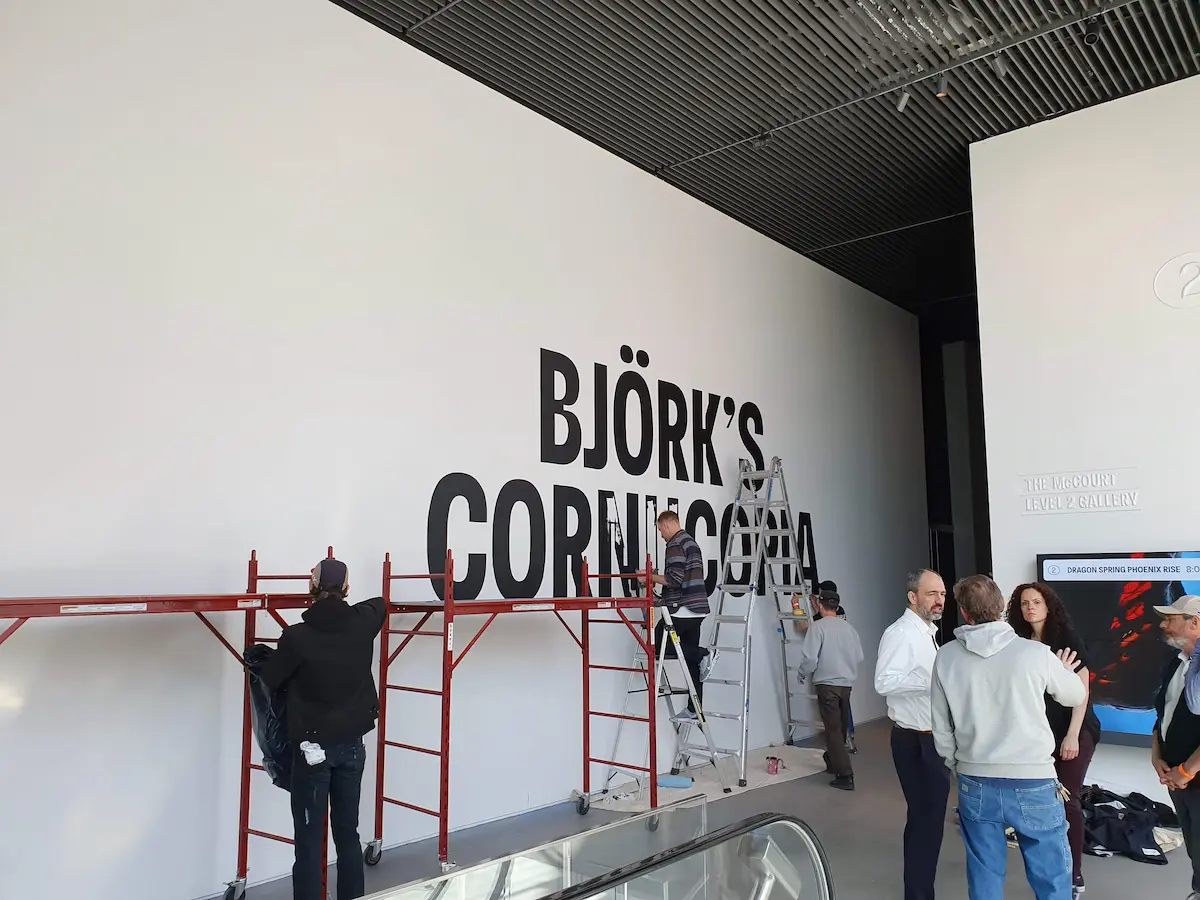
Björk's Cornucopia launch at The Shed in New York — and what an eye-opener to the American way of working. --- Having completed the Utopia tour, which contained several of the tracks that carried through into Cornucopia, the audio side was pretty well established — Left, Right, Sub, Fill. After a short break, we returned to Purfleet for pre-production on the upcoming launch. A significant part of that time was spent programming the show into d&b Soundscape — a new way of working for the whole team, and a long way from where we'd been on Utopia.
The visual department was working in parallel, ingesting content onto Disguise servers and plotting it against the audio. Lighting and video had been in the building for a few days before audio arrived, and walking in for the first time was genuinely exciting. This was a completely different production world to Utopia — not a pink revolve in sight. In its place: a full video wall, several high-powered laser projectors rigged directly from the stage, and a long front of house truss carrying six double-stacked projectors running a full edge blend. For the audio, we went full 360-degree immersive, built around the d&b audiotechnik Soundscape system. Triggering combined Qlab* for timecode-driven mid-show effects — bird sounds, environmental audio — and EnSnap handling the Soundscape object moves. Early days for Soundscape as a live touring tool, and a whole new workflow for FOH engineer John Gale. ---
Wireless & RF
On Björk I support Finnur Ragnarsson, the monitor engineer — though the New York run was engineered by Manu Goodwin. Southby Productions provided the bulk of the radio system, with all choir microphones supplied directly by Shure. New York was also my first real hands-on time with kit sent through Shure's Artist Relations team in the US — organised by Jenn from Artist Relations — alongside the choir package. During the run, one of Jenn's team came to visit the production, and I had the opportunity to give direct feedback on the Shure workflow from a tech's perspective: what worked, what could be better, and what I'd want to see develop in the future. It was my first real indication that something bigger was coming with Axient Digital.
RF coordination in New York brought its own specific challenge. A mixture of reading the documentation on deploying in the States — and, frankly, curiosity about some unusually high-powered transmitters showing up in my scans — led me to discover New York's public safety channels: protected frequencies you cannot interfere with under any circumstances. Operating in the centre of Manhattan, I had to work four of these protected transmitters into my overall frequency coordination plan. The Shure Axient Digital system's wide tuning range and RF efficiency meant this was manageable, but it required careful planning before a single system went live.
Console Infrastructure & Signal Chain
The audio system was built around DiGiCo's Optocore fibre loop: an SD7 Quantum at front of house, SD10 on monitors, and two SD-Racks loaded with 32-bit analogue cards handling all the analogue I/O. An Optocore MADI interface did the translation from the playback system into the DiGiCo Optocore network — keeping the signal chain consistent and latency-controlled throughout.
The input list divided into roughly three equal parts. Over a third of the show's inputs were wireless, handled entirely through Shure Axient Digital. Another third came from the stage itself — a percussion section, synth section, Reverb Chamber, and four wired Shure SM58 microphones. The final third came from Pro Tools via a redundant MacBook-based playback system. Playback also generated MIDI to both the percussion and synth racks, triggering patch changes on a song-by-song basis.
A Geeky Team in a Smart Building
One of the things that makes Björk's production stand out is the people. When the show is in and working, the crew doesn't stop — they use the time to make the whole system smarter. Lots of networking, StreamDecks, and a small monitor-position switcher giving access to a wide range of stage cameras and PTZs — so you always had a feel for how the show was reading from the audience's perspective, and how the artist was doing on stage.
A First Residency
This was my first theatre residency, and it was a different world to touring. Working within a fixed venue over an extended run meant spending time with directors, creatives, and a whole layer of production that you rarely encounter in a touring role. It broadened the way I think about production, about the relationship between audio and the wider creative vision, and about what's possible when a team has the time and space to really develop a show.
All in all — fabulous.